Sign Estimating vs. Quoting vs. Pricing: What’s the Real Difference
If you’ve searched for help with “sign estimating software,” “sign quoting software,” and “sign pricing software” and found yourself reading nearly identical articles, you’re not imagining it. In the sign industry, these three words get used interchangeably by shop owners, by software vendors, and often within the same conversation.
That’s not a mistake. It reflects how sign shops actually talk about the work. But if you’re trying to figure out what kind of tool or process you actually need, the overlap can make it harder to know what you’re looking for.
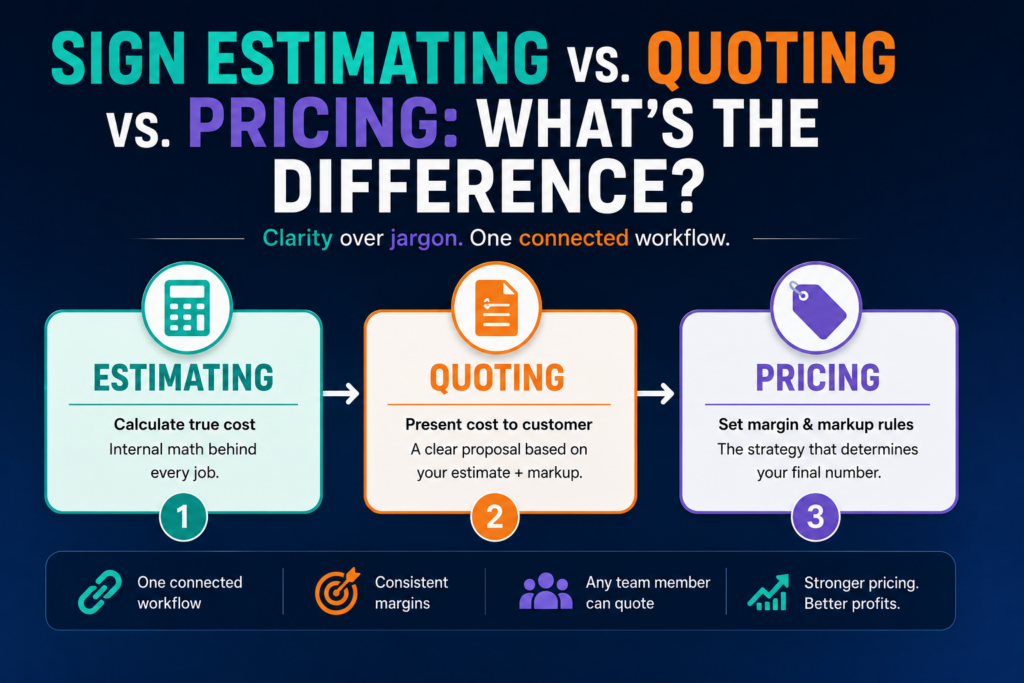
Here’s the practical breakdown, and why the distinction matters less than the terminology suggests.
Estimating: Figuring Out What a Job Will Cost
Estimating is the calculation step. It’s where you take a job’s specs, materials, labor, install time, and figure out what it will actually cost your shop to produce. This is the internal math: your labor burden, your material cost, your overhead allocation.
Estimating happens before a customer ever sees a number. It’s the foundation everything else is built on.
Quoting: Presenting That Cost to a Customer
Quoting is the output. It’s the document, the number, the formal proposal you hand or send to a customer based on your estimate. A quote includes your estimate plus your markup, formatted for someone who isn’t looking at your internal cost breakdown.
This is why the two terms blur together so easily. In a small shop, one person often does both steps back to back, estimate the job, quote the customer, without a clear line between them. The distinction becomes more visible as a shop grows and different people (or different systems) handle each step.
Pricing: The Strategy Behind the Numbers
Pricing is the layer above both. It’s the decision-making framework: your markup percentage, your minimum margin threshold, when you discount and when you don’t, how you price a rush job versus a standard one.
Pricing isn’t a single number. It’s the set of rules that determines what number comes out of your estimating and quoting process in the first place.
Why the Overlap Isn’t Actually a Problem
Here’s the part that matters more than the definitions: for most sign shops, these three activities aren’t separate departments or separate software categories. They’re stages of the same workflow, and they should be connected, not siloed.
A shop that treats estimating, quoting, and pricing as three disconnected steps usually ends up with three disconnected problems. The estimate doesn’t reflect true labor cost. The quote doesn’t consistently apply the shop’s markup rules. The pricing strategy exists in the owner’s head but not in the tool anyone’s actually using.
The real question isn’t “which of these three things do I need software for”. It’s whether your shop has one connected process that handles all three consistently, regardless of which word you use to describe it.
What This Looks Like in a Structured Shop
In a shop with a connected process:
- A job’s specs go into an estimate that reflects true labor burden and material cost
- The estimate automatically becomes a quote, formatted and markup-applied, without manual re-entry
- Pricing rules (minimum margins, discount thresholds) are built into the template, not left to individual judgment
- Any team member, not just the most experienced estimator, can produce a quote that reflects the shop’s actual pricing strategy
That’s the outcome that matters. Whether you call the tool that gets you there “estimating software,” “quoting software,” or “pricing software” is far less important than whether it actually connects all three stages.
Where SignTracker Fits In
SignTracker is shop management and estimating software built specifically for sign and wrap shops. It’s built around this exact connection: quoting templates carry your material costs, labor rates, and markup rules together, so an estimate, a quote, and your shop’s pricing strategy are one continuous process instead of three separate steps someone has to reconcile by hand.
If you’re evaluating software and keep seeing “estimating,” “quoting,” and “pricing” used interchangeably in what you find, that’s normal. What matters is whether the tool treats them as one workflow.
Frequently Asked Questions
Is sign estimating software the same as sign quoting software?
In practice, yes, most platforms marketed under either term handle both the cost calculation (estimating) and the customer-facing output (quoting). The terms describe different stages of the same tool, not different products.
Do I need separate software for pricing strategy?
No. Pricing strategy, your markup rules, minimum margins, discount policies, should be built into your estimating and quoting templates, not managed as a separate system.
Why do sign shops use these terms so inconsistently?
Because in most shops, one or two people handle all three stages without a formal handoff between them. The language reflects the workflow: it’s one job, described from different angles depending on who’s talking about it.
If your shop is ready to move from spreadsheet estimating to a structured system, SignTracker offers a free 14-day trial — no credit card required. Or watch the demo to see how quoting, job tracking, and production workflow connect in one platform built for sign shops.