Implementing Sign Shop Management Software: From Sign Maker to Business Operator
It Feels Like a Train Is Leaving the Station
From Sign Maker to Operator: Why More Shops Are Adopting Systems Now
Lately, I have been thinking a lot about why we are seeing such a surge in sign shops, especially smaller, independent ones, finally deciding to adopt technology.
And I do not think it is a coincidence.
There is a broader shift happening right now. AI is advancing quickly. Automation is becoming real. The pace of business is picking up.
Most shop owners do not sit around reading about AI.
But they can feel it.
It feels like a train is leaving the station and they are getting left behind.
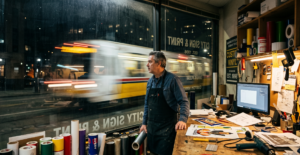
You do not need to understand every piece of it, but you know things are changing. You know expectations are rising. And you know that staying where you are probably is not a long-term strategy.
So the question becomes:
“Are we set up for where things are going?”
For a lot of shops, that question leads to something they have put off for a long time:
Implementing sign shop management software
Sign Makers vs. Business Operators
Here is something I have come to believe after years in this industry:
Sign makers are incredible builders.
They can make anything.
They are creative.
They work with their hands.
They take ideas and turn them into something real.
That is the craft.
But the business side?
That usually comes later.
And that is where things get harder.
Because running a sign shop is not just about producing great work. It is about:
- Managing jobs
- Coordinating people
- Pricing accurately
- Keeping production moving
At some point, every shop hits that transition:
You are not just making signs anymore. You are running a business.
And that is exactly where most shops start to struggle.
It is also where the right system starts to matter.
When You Realize Your System Is Not a System
Most shops do not start broken.
They start simple.
A whiteboard. A spreadsheet. A system in your head.
And for a while, it works because you are close to everything.
I remember what that feels like.
You know every job. You know what is due. You know who is working on what.
But then the volume increases.
And things start to slip:
- A quote takes longer than it should
- A job detail gets missed
- Someone asks for a status update and you have to go find the answer
Individually, these are not major problems.
But together, they create friction.
And the biggest realization usually hits like this:
“If I am not here, things slow down.”
Not because the team is not capable, but because everything runs through you.
That is the owner bottleneck.
And it is one of the clearest signs that the business has outgrown its current systems.
The Phase Most Shops Go Through
Before shops adopt real systems, there is usually a middle phase.
I call it the patchwork phase.
You try to fix the problem by adding tools:
- Spreadsheets for quotes
- Trello or a task app
- Dropbox or Google Drive for files
- Email for communication
On paper, it feels like progress.
In reality, it creates new problems:
- Information lives in multiple places
- Things get duplicated
- No one is fully sure where to look
- Visibility actually gets worse
At some point, managing the tools becomes as much work as managing the shop.
That is usually when the thinking shifts from:
“What tool do we need?”
to:
“We need one system.”
Why Estimating Is Where Everything Breaks First
Most shops do not start by searching for management software.
They start with quoting problems.
Things like:
- “Why does every estimate feel different?”
- “Why does everything depend on me?”
- “Why does quoting take so long?”
Estimating is where the cracks show first.
Because if your pricing is not consistent, your margins are not consistent.
And if quoting is slow, everything behind it backs up.
This is where sign estimating software starts to make sense.
Not as a big operational shift, but as a way to:
- Standardize pricing
- Speed up quotes
- Give the team confidence
And then something important happens.
Quotes turn into jobs.
Jobs need tasks.
Tasks need coordination.
And suddenly, you are not just solving estimating anymore.
You are rethinking your entire workflow.
The Moment Everything Clicks
There is a moment I have seen happen over and over again.
It is simple, but it is powerful.
It is the first time a shop sees all of their jobs in one place.
Not scattered across emails, notes, and conversations.
But organized. Visible. Trackable.
You do not have to ask:
- “Where is this job?”
- “What is next?”
- “Who is working on it?”
You can just see it.
That is the shift.
From chasing information
to having visibility
From reacting
to managing
And for a lot of shop owners, that is the first time things feel under control again.
The Biggest Fear: “We Are Too Busy to Change”
Almost every shop I talk to has the same hesitation:
“We are too busy to implement something new.”
I get it.
When you are already stretched, the idea of changing systems feels risky.
But what I have seen in practice is this:
The right system does not slow you down.
It removes friction almost immediately.
Because instead of:
- Chasing information
- Repeating conversations
- Relying on memory
You start working from a shared system.
And that actually gives time back.
What Shops Are Really Looking For
When you strip everything back, most shop owners want the same things:
- To know where every job stands
- To have consistent estimating
- To give their team clear direction
- To stop being the bottleneck
They are not looking for complexity.
They are looking for control.
And the mistake I see too often is choosing software that is too heavy for the job.
The best system is not the one with the most features.
It is the one your team actually uses every day.
Why This Shift Is Happening Now
Coming back to where we started, this shift is not random.
The industry is changing.
Technology is moving faster.
AI is starting to influence how businesses operate, even if it is not obvious yet.
And shop owners can feel it.
That train is leaving the station.
The shops that are prepared are not necessarily the most technical.
They are the ones with:
- Structured workflows
- Consistent estimating
- Clear visibility
They are the ones that have moved from manual effort to operational systems.
Building a Business That Can Outlast You
There is one more piece that does not get talked about enough.
And it is probably the most important long term.
At some point, every owner has to think about:
- Stepping back
- Handing the business off
- Or selling it
And here is the reality:
If everything lives in your head, the business is hard to transfer.
New owners do not know:
- How jobs are tracked
- How pricing works
- How production is coordinated
But when you have systems in place:
- Workflows are documented
- Lobs are visible
- Estimating is repeatable
- The team operates independently
You are not just running a shop.
You are building something transferable.
Something that someone else can step into and understand.
That is what increases the value of the business.
That is what allows you to exit cleanly.
Where SignTracker Fits
This is exactly the gap SignTracker was built to fill.
Not as complex enterprise software.
Not as a generic project management tool.
But as a system designed for how sign shops actually operate:
- Quoting
- Job tracking
- Task coordination
- Production visibility
Simple enough to adopt quickly.
Structured enough to support growth.
Because at the end of the day, the goal is not to add software.
It is to move from:
- Chaos to clarity
- Owner dependent to team driven
- Reactive to controlled
Conclusion: This Is About More Than Software
This shift is not about technology.
It is about how you run your business.
Every sign shop reaches a point where effort alone is not enough.
Where memory is not enough.
Where growth starts to create stress instead of opportunity.
That is the moment where systems matter.
And once those systems are in place, something changes.
For the first time, the shop does not feel like something you are chasing.
It feels like something you are actually running.
What’s Next?
If you are starting to feel that shift in your own shop, the next step is simple:
Start a free trial of SignTracker and build a real job inside the system.
That first moment of visibility, when you can see your workflow clearly, is usually when everything clicks.